Some of the most meaningful facilitation work I do happens at the edges of what's planned — in the moments when a group surprises me, when a framework emerges from conversation, or when a team demonstrates a kind of collective capacity I hadn't anticipated.
Two recent experiences brought this home for me.
While facilitating a team retreat with a client, I watched a group navigate change and unexpected shifts with genuine skill. I was impressed. Not every team moves through uncertainty this gracefully — in fact, many get stuck there, spinning in ambiguity without tools to find their footing.
Given how much change organizations are navigating right now, I've been leaning on two of my favorite tools to help teams adapt in real time: the Before Action Review (BAR) and the After Action Review (AAR) — both learned from Randall Smith at PowerLabs, through his course Nerdy Movement.
The AAR, in particular, asks four simple questions:
What were our intended results?
What were our actual results?
What caused our results?
What lessons should we take forward?
These questions create space for honest reflection, and they build a team's capacity to learn continuously — not just when something goes wrong, but as a regular practice. They're conversations I genuinely love, and they're central to the work I do.
Recently, I got to bring this same spirit of facilitation into a very different context: my own small northeastern town, where volunteers run our local government. So many remarkable leaders donate their skills, time, and expertise to serve on committees and boards — quietly holding the infrastructure of community life together.
I had the pleasure of co-planning and co-facilitating a gathering that brought all those boards and committees into the same room for the first time — to better understand connections across separate projects, find alignment, and explore how to coordinate more effectively. The goal, at its heart, was the long-term resilience and sustainability of our town.
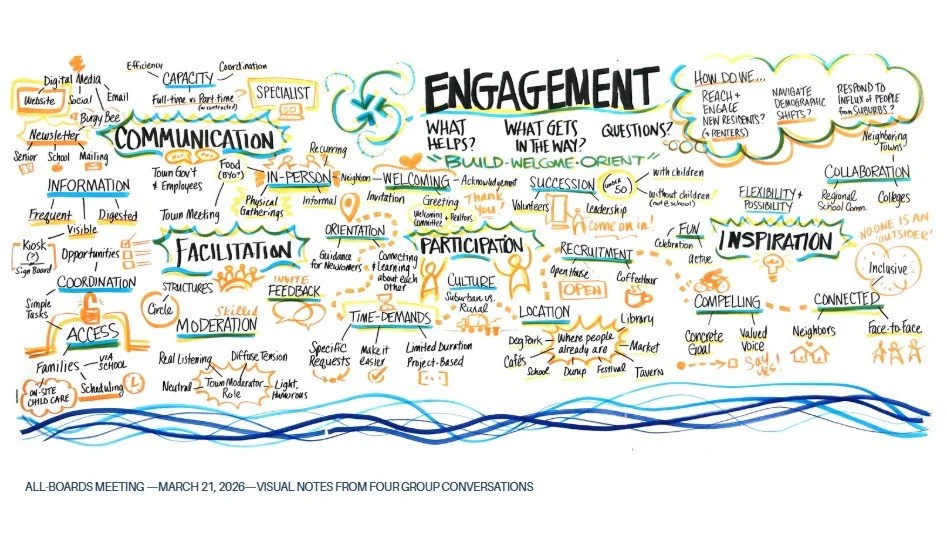
I volunteered to facilitate a breakout on engagement — specifically, what it would take to invite broader participation in shaping the town's future. Through layered conversation about what helps, what gets in the way, and what puzzles us, a framework began to emerge: build participation, welcome people in, and orient newcomers to local government. Themes around communication, in-person connection, one-on-one invitations, and — importantly — fun rose to the surface.
A special appreciation to Seth Gregory, who dropped into a somatic flow of listening, drawing, and offering key questions that sharpened our facilitation in real time. And to Nicole Okumu from the Dpict team, who held the overall faclilitation, digitized the graphic notes, and created beautiful summary slides that captured what we built together.
Whether I'm working with an organizational team navigating workplace uncertainty or a room full of volunteer town leaders trying to coordinate across silos, the through-line is the same: people have more wisdom than they're often given space to access. Good facilitation creates that space and invites collective learning. The right questions — asked at the right moment, with the right conditions — can surface frameworks, reveal alignment, and build the kind of collective capacity that sustains communities over time.
I'd love to hear what reflection and learning tools you rely on. And if you or someone you know could use facilitation support — for a team retreat, a community gathering, or something in between — I offer a free one-hour discovery session to explore what's needed and what's possible.
