Sometimes I struggle with belonging — unsure where I fit in, how to join a group, how to stay present when the weight of it all feels like too much. This is something that comes up periodically: during a multi-day meeting that leaves me feeling on the outside, or a walk in the woods that cracks me open unexpectedly.
A few weeks ago, while traveling, I found myself feeling like an outsider during a gathering I'd traveled a long way to attend. The feeling was familiar enough that I knew what I needed: to center. To steady. Drawn to a circle of huge trees just outside the meeting room, I walked to them and joined their circle.
Those trees were so sturdy. They reminded me of all the ancestors who had walked this same path, fighting for liberation, long before I arrived. Standing there, I soaked up the morning sun streaming through the leaves, breathed into my feet, aligned my shoulders with the circle, and reminded myself: I'm never alone. Even when it's hard with the humans, there's a place for me — and for you — with the trees, the sun, and the ancestors who walk beside us. That small moment of connection was just enough to help me rejoin the meeting, try again, and say good morning to the person next to me.
This kind of resourcing — returning to the body, to the natural world, to something larger than the moment — is something I've been learning to treat as a serious practice rather than a last resort.
Recently, a coaching client, a family member, and I all found ourselves overwhelmed at the same time. I dug up an old podcast featuring Emily and Amelia Nagoski, authors of Burnout: The Secret to Unlocking the Stress Cycle, and it reminded me of something essential the authors write about: stress lives in our bodies, and it needs to move through the body to complete its cycle.
Some of what actually helps is so simple — a 20-second hug, squeezing and releasing muscles, taking a walk, making something with the hands. Not bypassing the stress, but giving it somewhere to go.
Which brings me to this morning. I cried on my walk today.
I used to feel strange admitting that. Now I understand it as part of the same practice. There's something about being outside, alone, in the woods, that gives me access to a broader range of feelings than I can touch indoors. I'm learning to welcome the tears as a sign that I'm allowing myself to feel, rather than letting feelings get stuck and harden somewhere in my chest or jaw.
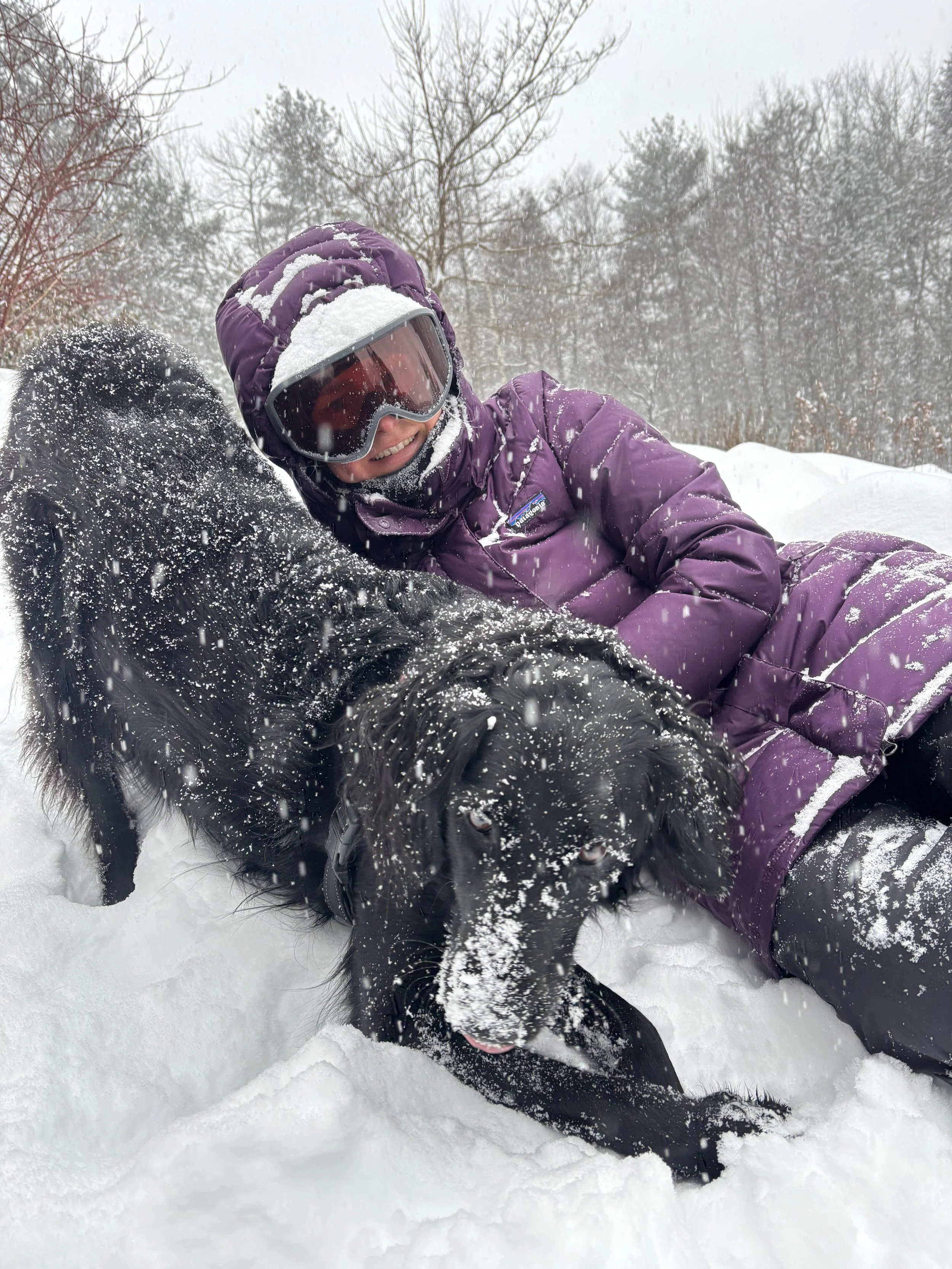
My walking partner, Luna the labradoodle, knows something about this too. When she gets upset, the hair on her back rises. She barks, she growls. And then — she shakes. Her whole body releases the tension in full-body shudders, and seconds later, she's back to playing, napping, snuggling. My walking tears feel a lot like Luna's shake: the body completing the stress cycle.
As Moya Sarner writes in The Guardian, allowing ourselves to feel grief and rage — rather than rushing toward a reframe — is what opens the door from denial and depression toward growth and possibility. It takes time. But it's a way through.
So here's what I keep coming back to: belonging, stress, feeling — these aren't separate problems with separate solutions. They're all invitations into the same practice. The practice of returning to your body. Of letting something move through you rather than around you. Of finding your circle, whether that's a ring of trees, a 20-second hug, a walk with a dog, or a good long cry in the woods.
What helps you stay present, open, and connected? What gets you through the intense times?
