What Fighting Taught Me

I come from a family of fighters.
The fights contain multitudes: rage, grief, fear.
Fighting is one of the ways my family answers the questions: "Do you love me? Can you see me? Will you be with me in this fight, and will you still be with me after this fight?"
My body learned to move away from fights most of the time, especially fights that contain big rage. As a result, it takes practice for me to proactively choose to move toward a fight or move against in a fight.
In my family of origin, I learned to expect conflict. Doors slam. Voices get loud. Arguments happen, and we keep moving. We get through.
I value precision, so I want to share some definitions with you.
The definition I like the best comes from the Embodiment Institute: conflict is "The meeting place of two or more seemingly oppositional beliefs, needs, positions, or goals…Conflict is one of the primary ways that we change and change things." 1
Whereas generative conflict creates “more possibilities, greater connection, and fuller expression”, writes The Wildfire Project. 2
The pressures of the context we organize in, including racial capitalism, polycrisis, and rising authoritarianism, add trauma on top of trauma. Generative conflict conversations help us avoid layering on more.
I've learned additional things about fighting through many years of organizing, especially when I've been at the helm of coalitions.
When conflict is navigated well, it can feel like dynamic tension and create space for new possibilities and options that weren’t previously available to the group. Other times, conflict can feel like moving through slippery, gooey, gross muck; the kind that makes a sucking sound and kind of stinks.
Most organizing activities, including coalition building, involve working with and among different people, strategies and tactics. That's what makes our coalitions powerful enough to win lasting change that improves people's lives.
But so many of us, myself included, learned to fear the conflict that often emerges when we organize together over time. This is especially true because all too often in social movement work we oscillate between conflict avoidance and cancel culture. 3
To be clear, conflict avoidance can be wisdom. Not all conflicts need to be faced. However, avoiding conflict often has costs, and entering into conflict can have costs too. Power can complicate the costs and related choices.
Conflict avoidance can also cause unaddressed disagreement to turn into full-blown conflict.
I once worked in an organization that was so averse to conflict that entire departments were created to work around unresolved disagreements. Creating new departments just magnified the problems at the heart of the original disagreement.
Unsurprisingly, many organizers I talk with name conflict as a top challenge. When we work together, I support and accompany them to feel lit up and proud of their work again as we honor and explore conflict.
Right now, I’m re-grounding myself in existing related approaches, principles, definitions, and resources I draw on for my conflict work.
I'd like to share some of what I am orienting to that describes why surfacing conflict in groups is important to me.
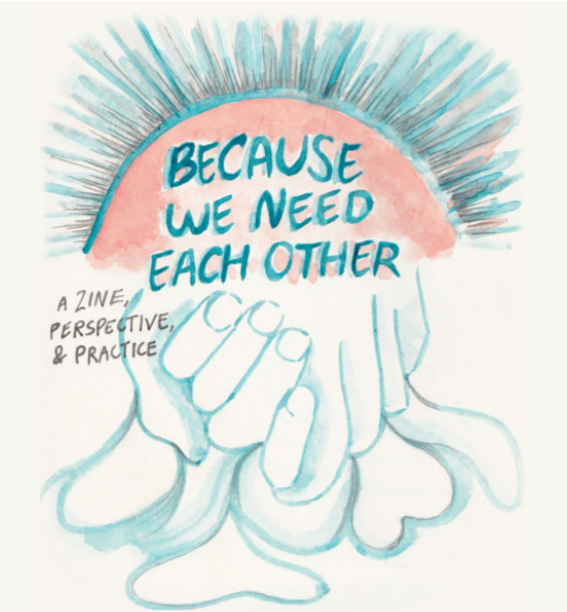
Artwork by Kylie Tseng of relationshipecology.net, as it appears in the Because We Need Each Other zine linked below.
Conflict presents learning opportunities. Building a culture of learning helps teams respond to complexity, adapt to a shifting political context, and stay open to input that shows what's working and what isn't.
Learning to navigate conflict well is also essential for strategy and team-building. Without it, we're less likely to have the strategy and cohesion needed to win.
As Priya Parker puts it, "Groups can't sustain without love, and they can't sustain without conflict. In other words, healthy community needs healthy conflict." Organizing means bringing people together toward a common goal — so cultivating healthy groups, conflict included, is essential.
There are so many resources and tools for navigating conflict. I won't try to catalog them here, but I'd be happy to talk with you about it. Instead, I offer three of my favorite resources and three new resources.
I'm particularly drawn to approaches from the Embodiment Project, the Six Team Conditions, and the Wildfire Project. Together, their resources help me think through what’s happening at the systemic and structural levels that influence the behavior of the team, what’s going on interpersonally with the team and what’s happening with individuals.
The Embodiment Project offers an Embodied Conflict Workbook by Prentis Hemphill for individuals to explore their conflict styles.
The Six Team Conditions offers empirically studied techniques for team effectiveness. This blog is an introduction: Conditions Thinking and How to Have Great Teams, by Ruth Wageman.
The Wildfire Project invites groups to assess their collective conflict style using their Conflict Culture Assessment Worksheet, written in part by Michael Strom.
The following new resources are contributions to a conflict toolbox organizers can use to deepen conflict skills.
Because We Need Each Other, by Erika Sasson, Celia Kutz, Kazu Haga and Shilpa Jain, is a zine that builds on the much longer four-part article series by the same name, criticizing cancel culture in movements, and inviting new pathways to explore conflict.
Work of Love, a song by Lyndsey Scott, written during Operation Metro Surge in Minneapolis, invites the listener and singer to feel their way through interpersonal conflict, with a heart-centered chorus: “I'm not mad at you. I want us both to thrive.”
The Art of Fighting: The Transformative Power of Conflict, a book by Priya Parker, argues that groups need disagreement to flourish and offers skills specifically oriented to navigating what she calls "heat" in groups.
Connecting with you
Did anything you read here pique your curiosity? If you like any of the definitions I compiled or read one of the resources I suggested and want to talk about it, reply to maryalicecrim at gmail.com. I’d love to talk with you.
If you, your organizing group or your organization would like support transforming conflict, I’d love to help. I support changemakers who have big hearts and fierce passion but struggle with conflict, burnout, loneliness or lack of support.
I offer a free one-hour session where we can get to know each other and decide if we’re a good fit for what you need.
Bringing Conflict Into Focus
Here’s what a recent client shared about what’s possible with support to explore conflict.
“Coaching is helping me get to the root of feelings of isolation and fear of conflict that have been keeping me stuck in parts of my work. After identifying the root causes, I’ve been able to move through the stuckness and into action, using the tangible activities and concrete plans I apply in my work right away. ”
Seasonal Spotlight
Outside of work, I'm winding down my outdoor swims for the season, harvesting and processing garden gifts such as tomatoes and jalapeños, and basking in the joy of bringing in my first homegrown pumpkins and gourds.
What Else Caught My Attention Recently
I’m really enjoying this essay, The Opposite Of The Apocalypse Is A Neighborhood, including this quote: 4
““... every time we are joyfully, capaciously human to each other, we remember the one thing the master of the AI universe want us to forget. We don’t need the robots. We never did. We need to be less alone, and less vulnerable to the whims of billionaires...””
Embodied Conflict Workbook, The Embodiment Institute, 2021
Moving Toward Conflict for the Sake of Good Strategy, Medium, January 20, 2020
Because We Need Each Other, Part I: Origin Story, Convergence Magazine, April 2, 2025
The Opposite Of The Apocalypse Is A Neighborhood, The White Pages, September 15, 2026
Thanks to my teachers at Embodying Racial Justice and PowerLabs, who influenced my conflict work but were not previously named in this piece.
